
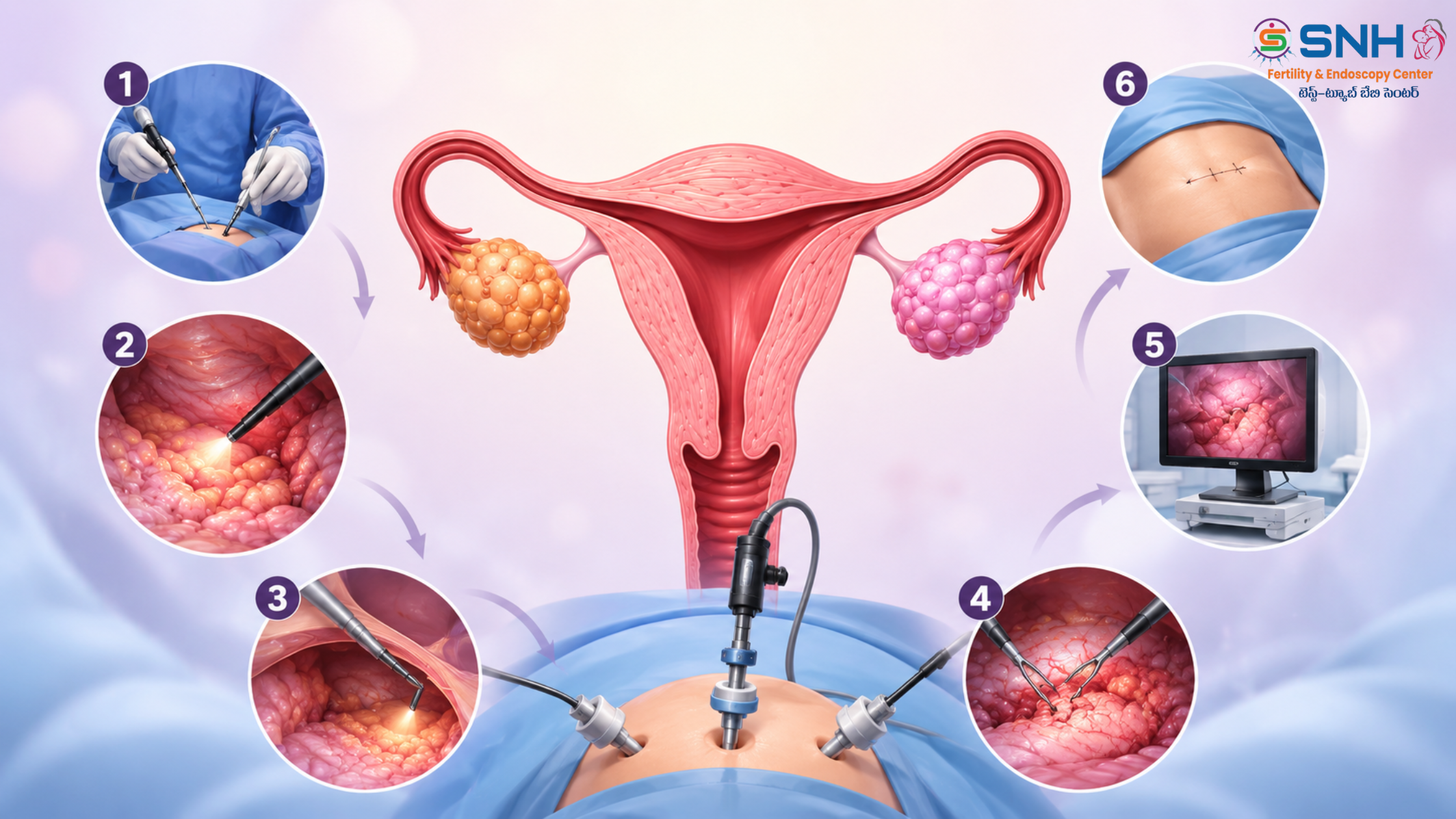
How Laparoscopy Can Help Diagnose Infertility
Infertility can have many possible causes, and identifying the underlying reason is an important part of choosing the right treatment. Problems with ovulation, fallopian tubes, endometriosis, pelvic adhesions, uterine conditions, and male-factor infertility can all affect a couple’s ability to conceive.
Doctors usually begin infertility evaluation with less-invasive investigations such as medical history, blood tests, ultrasound, semen analysis, and tests to assess the fallopian tubes. However, in some situations, these tests may not provide enough information about what is happening inside the pelvis.
This is where laparoscopy may have an important role.
Laparoscopy is a minimally invasive surgical procedure that allows a fertility specialist to directly examine the reproductive organs and surrounding pelvic structures. It may help identify conditions such as endometriosis, pelvic adhesions, and certain abnormalities affecting the fallopian tubes.
If you are searching for a Trusted Fertility Hospital in Nellore, understanding laparoscopy, when it may be recommended, and how it can contribute to infertility evaluation can help you make informed decisions about your fertility care.
What Is Laparoscopy?
Laparoscopy is commonly known as keyhole surgery. It involves making small incisions in the abdomen through which a thin instrument called a laparoscope is inserted. The laparoscope contains a camera that allows the surgeon to view the pelvic and abdominal organs on a screen.
During a fertility-related laparoscopy, the doctor may examine structures such as:
- Uterus
- Ovaries
- Fallopian tubes
- Pelvic lining
- Surrounding tissues
- Areas where adhesions or endometriosis may be present
The procedure is generally performed under general anaesthesia. Depending on what the doctor finds, laparoscopy may be used for diagnosis alone or combined with treatment of certain conditions during the same procedure.
According to the NHS guidance on laparoscopy, the procedure is used for diagnosing and treating a variety of conditions through small surgical incisions.
For patients consulting a Trusted Fertility Hospital in Nellore, the decision to undergo laparoscopy should be based on individual symptoms, medical history, previous test results, and the suspected cause of infertility.
How Can Laparoscopy Help Diagnose Infertility?
The major advantage of laparoscopy is that it provides the surgeon with a direct view of the pelvic organs. Some abnormalities may not be completely visible through routine imaging tests.
Here are some of the ways laparoscopy can contribute to infertility evaluation.
1. Detecting Endometriosis
Endometriosis is a condition in which tissue similar to the lining of the uterus grows outside the uterus. It can affect the ovaries, fallopian tubes, pelvic lining, and other nearby structures.
Endometriosis may be associated with:
- Painful periods
- Chronic pelvic pain
- Pain during sexual intercourse
- Pain during bowel movements or urination, particularly around menstruation
- Difficulty becoming pregnant
Some forms of endometriosis can be difficult to identify through routine investigations. Laparoscopy allows the surgeon to directly inspect the pelvis for endometriosis-related lesions and other abnormalities.
The American Society for Reproductive Medicine (ASRM) discusses the relationship between endometriosis and infertility and the role of surgical evaluation in selected cases.
2. Identifying Pelvic Adhesions
Pelvic adhesions are bands of scar tissue that can form between organs or tissues. They may develop after previous surgery, pelvic infections, inflammation, or endometriosis.
Adhesions can sometimes interfere with the normal relationship between the ovaries, fallopian tubes, and surrounding pelvic structures.
Because adhesions may not always be clearly identified through routine imaging, laparoscopy can provide direct visualization.
When appropriate, the surgeon may also be able to treat certain adhesions during the same procedure.
3. Evaluating the Fallopian Tubes
Healthy, functioning fallopian tubes are important for natural conception. The egg normally travels from the ovary into the fallopian tube, where fertilization can occur.
A procedure called chromopertubation may sometimes be performed during laparoscopy. A dye is introduced through the cervix while the surgeon observes whether it passes through the fallopian tubes.
This can help identify certain tubal blockages.
However, laparoscopy is not routinely required simply to check whether the fallopian tubes are open. Less-invasive tests such as hysterosalpingography (HSG) or other tubal assessments are commonly used first, depending on the patient’s circumstances.
The ASRM fertility evaluation guidelines explain that infertility investigations should be individualized and that invasive procedures should be performed when clinically appropriate.
4. Examining the Pelvis Directly
Sometimes a woman’s symptoms or previous investigations suggest that there may be a pelvic problem, but the exact cause remains uncertain.
Laparoscopy allows the fertility specialist to directly examine the pelvic anatomy.
This can provide information about:
- The appearance of the ovaries
- The condition and position of the fallopian tubes
- Pelvic adhesions
- Endometriosis
- Abnormal pelvic tissue
- Other visible pelvic abnormalities
This information may help the fertility team decide whether natural conception, surgery, IUI, IVF, or another treatment approach may be appropriate.
When Is Laparoscopy Recommended for Infertility?
Laparoscopy is not necessary for every person experiencing infertility.
Most infertility evaluations begin with less-invasive investigations. A fertility specialist may recommend laparoscopy when there is a specific clinical reason to suspect a pelvic abnormality.
Possible reasons include:
- Suspected endometriosis
- Significant or unexplained pelvic pain
- Previous pelvic surgery
- Previous pelvic infection
- Suspected pelvic adhesions
- Abnormal findings from other investigations
- Certain suspected fallopian tube or pelvic abnormalities
- Infertility where the medical history suggests a pelvic cause
For example, a woman with severe menstrual pain and difficulty conceiving may be evaluated for possible endometriosis. Similarly, someone with a history of pelvic surgery or infection may require further evaluation for adhesions or tubal problems.
A Trusted Fertility Hospital in Nellore should assess each patient individually rather than recommending laparoscopy as a routine test for everyone.
Can Laparoscopy Treat Infertility Too?
In selected cases, laparoscopy can be both diagnostic and therapeutic.
If the surgeon identifies certain abnormalities during the procedure, treatment may sometimes be performed at the same time.
Depending on the condition, this may include treatment of:
- Certain pelvic adhesions
- Some endometriosis lesions
- Selected pelvic abnormalities
However, treating a pelvic condition does not guarantee pregnancy.
Fertility is influenced by many factors, including:
- Age
- Ovarian reserve
- Egg quality
- Fallopian tube function
- Sperm quality
- Duration of infertility
- Presence and severity of endometriosis
- Previous fertility treatments
After laparoscopy, your fertility specialist can discuss whether trying naturally or considering treatments such as IUI or IVF would be appropriate.
What Happens During Laparoscopy?
The exact procedure can vary depending on the reason for surgery, but a typical fertility-related laparoscopy may involve several stages.
Step 1: Pre-operative assessment
Your doctor reviews your medical history, symptoms, medications, previous surgeries, and fertility investigations. You may also undergo tests to make sure you are medically suitable for the procedure.
Step 2: Anaesthesia
Laparoscopy is generally performed under general anaesthesia, so you will be asleep during the operation.
Step 3: Small abdominal incision
A small incision is usually made near the belly button.
Step 4: Inserting the laparoscope
The laparoscope is inserted through the incision, allowing the surgeon to view the pelvic organs.
Step 5: Examination
The surgeon examines the uterus, ovaries, fallopian tubes, and surrounding tissues for abnormalities.
Step 6: Additional procedures
If clinically appropriate, the doctor may perform dye testing or treat certain abnormalities identified during the operation.
The surgical team will explain the specific procedure and expected recovery before treatment.
Is Laparoscopy Painful?
Because laparoscopy is generally performed under anaesthesia, you should not feel the procedure itself.
Some temporary discomfort can occur after surgery. Depending on the procedure, patients may experience:
- Mild abdominal pain
- Bloating
- Tiredness
- Discomfort around the incision
- Shoulder-tip pain related to the gas used during the procedure
Recovery varies from person to person. Recovery may also take longer when additional surgical treatment is performed.
Your doctor will provide instructions regarding medication, physical activity, wound care, and when you can return to your normal routine.
Laparoscopy vs Ultrasound: What’s the Difference?
Ultrasound and laparoscopy are different investigations and provide different types of information.
| Investigation | What it can help evaluate |
|---|---|
| Ultrasound | Uterus, ovaries, follicles and some pelvic abnormalities |
| HSG | Uterine cavity and whether the fallopian tubes appear open |
| Laparoscopy | Direct visualization of pelvic organs, endometriosis and adhesions |
| Semen analysis | Sperm count, movement and other sperm characteristics |
| Blood tests | Hormonal and other fertility-related factors |
The best investigation depends on the patient’s symptoms, medical history, age, previous results, and suspected cause of infertility.
Is Laparoscopy Required for Every Infertility Patient?
No.
This is an important point for couples considering fertility treatment.
A laparoscopy is an invasive procedure, so it should generally be recommended when there is a reasonable clinical indication.
According to ASRM, laparoscopy is not routinely recommended as part of the initial infertility evaluation when there is no specific indication for surgery.
A fertility specialist may therefore recommend other investigations first.
The purpose is to identify the likely cause of infertility while avoiding unnecessary procedures.
How Can a Trusted Fertility Hospital in Nellore Help?
Infertility can involve one or multiple factors, which is why a comprehensive evaluation is important.
When choosing a Trusted Fertility Hospital in Nellore, couples should look for a centre that offers individualized evaluation and explains why a particular investigation or treatment is being recommended.
At SNH Fertility Care, fertility care includes services such as IVF/ICSI, IUI, male infertility treatment, PCOD-related fertility care, fertility preservation, and endoscopy and laparoscopy-related services.
A personalized evaluation can help determine whether laparoscopy is appropriate or whether another diagnostic test or fertility treatment may be more suitable.
When Should You Consult a Fertility Specialist?
You may consider consulting a fertility specialist if:
- You have been trying to conceive without success
- Your periods are irregular or absent
- You experience severe menstrual or pelvic pain
- You have suspected or diagnosed endometriosis
- You have previously had pelvic surgery
- You have a history of pelvic infection
- You have known tubal problems
- You have experienced repeated fertility treatment failure
- You have concerns about your partner’s fertility
ASRM generally recommends infertility evaluation after 12 months of trying to conceive for women younger than 35 and after 6 months for women aged 35 or older. Earlier evaluation may be appropriate when risk factors are present or when a woman is over 40.
Frequently Asked Questions About Laparoscopy and Infertility
Can laparoscopy detect the cause of infertility?
Laparoscopy does not diagnose infertility itself. It can help identify certain pelvic conditions that may contribute to infertility, including endometriosis, adhesions, and some tubal abnormalities.
Can laparoscopy unblock fallopian tubes?
In selected cases, surgery may be able to treat certain tubal or surrounding pelvic problems. However, the treatment possibilities depend on the location and severity of the problem.
Is laparoscopy better than HSG?
They serve different purposes. HSG is commonly used to evaluate the uterine cavity and fallopian tube patency, while laparoscopy provides direct visualization of the pelvic organs. Your fertility specialist can determine which investigation is appropriate for you.
Can I become pregnant naturally after laparoscopy?
Some patients may conceive naturally after an underlying pelvic condition is treated, but pregnancy outcomes vary. Age, ovarian reserve, sperm health, tubal function, and the underlying condition all influence fertility.
Is laparoscopy a routine infertility test?
No. It is generally not recommended as a routine first-line investigation for every infertility patient. It may be considered when there is a specific clinical indication.
How long does it take to recover from laparoscopy?
Recovery depends on the type of procedure performed and whether additional treatment was carried out. Your surgeon will provide personalized recovery instructions.
Laparoscopy can be a valuable tool in the evaluation of selected infertility cases. By allowing a surgeon to directly examine the pelvis, it may help identify conditions such as endometriosis, pelvic adhesions, and certain tubal or pelvic abnormalities that may not be fully explained by routine investigations.
However, laparoscopy is not necessary for every person experiencing infertility. A fertility specialist should first consider the patient’s symptoms, medical history, previous test results, age, and other fertility factors before recommending an invasive procedure.
If you are searching for a Trusted Fertility Hospital in Nellore, a personalized fertility evaluation can help you understand which diagnostic tests and treatment options are appropriate for your situation.
Take the Next Step With SNH Fertility Care
Understanding the cause of infertility is an important first step toward choosing the right treatment. If you are experiencing difficulty conceiving or have symptoms that may indicate a pelvic condition, consult a fertility specialist for an individualized evaluation.
Looking for a Trusted Fertility Hospital in Nellore? Explore fertility evaluation and treatment options at SNH Fertility Care:
https://snhfertilitycare.in/