
IVF vs IUI: Which Fertility Treatment Is Right for You?
When you are trying to conceive and pregnancy is taking longer than expected, understanding your fertility treatment options can make the next step easier. Two commonly discussed assisted reproductive treatments are IUI (Intrauterine Insemination) and IVF (In Vitro Fertilization).
But which one is right for you?
The answer depends on several factors, including your age, fertility diagnosis, ovarian reserve, fallopian tube health, sperm quality, previous treatments, and how long you have been trying to conceive.
For couples looking for personalized fertility care, consulting a qualified fertility specialist at a Trusted Fertility Hospital in Nellore can help determine whether IUI, IVF, or another treatment approach is appropriate.
This guide explains the key differences between IVF and IUI, how each treatment works, who may benefit from them, and what factors can influence the treatment decision.
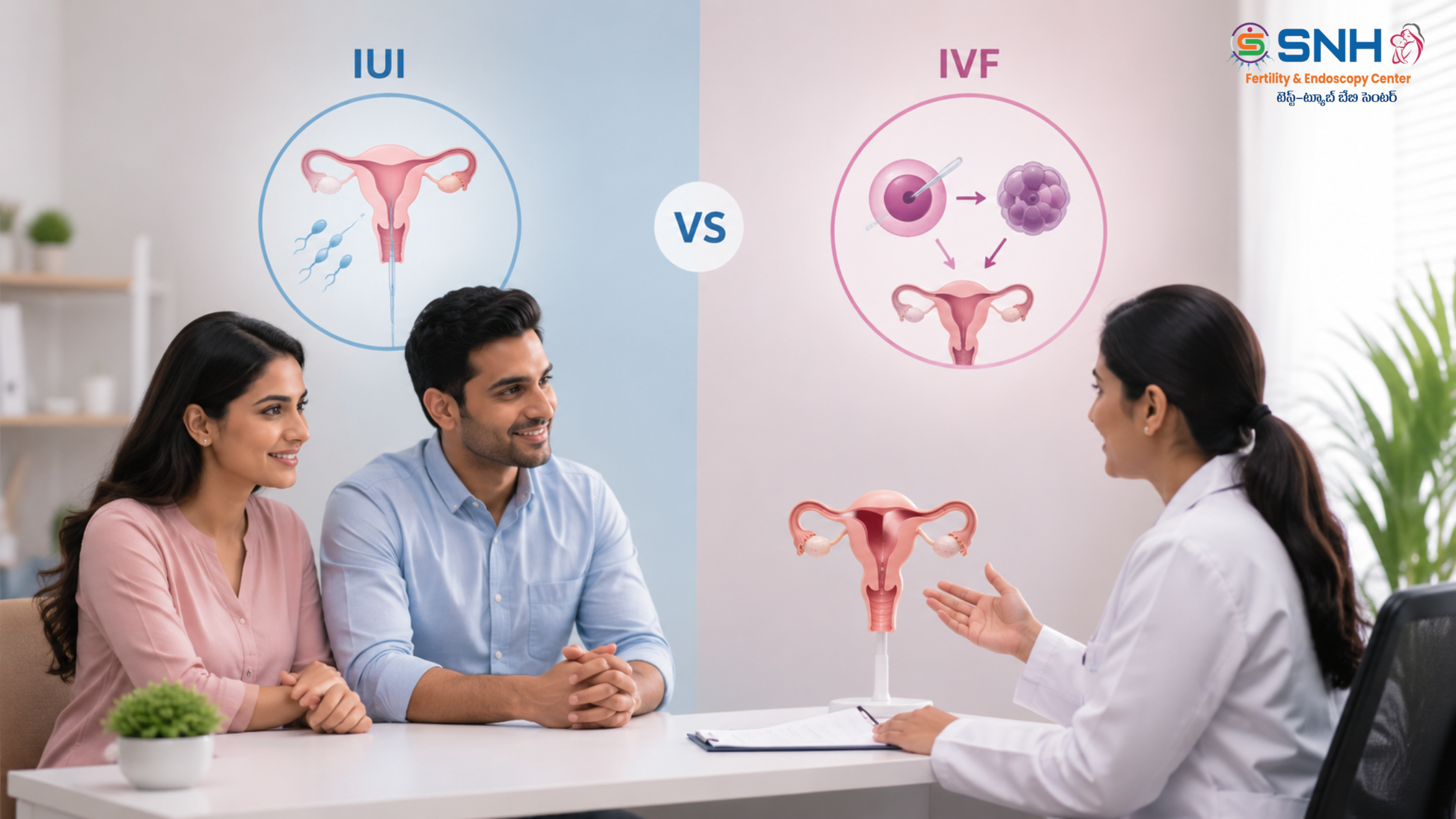
IUI places specially prepared sperm directly into the uterus around the time of ovulation, while IVF involves fertilizing an egg with sperm in a laboratory and transferring the resulting embryo into the uterus.
IUI is generally less invasive and simpler than IVF, while IVF involves more stages and laboratory procedures but can be appropriate for a wider range of infertility causes.
Neither treatment is automatically “better.” The right option depends on the individual fertility situation.
What Is IUI?
Intrauterine insemination (IUI) is a fertility treatment in which prepared sperm is placed directly into the uterus around the time of ovulation.
Before IUI, the sperm sample is processed to concentrate healthier, more motile sperm. The prepared sample is then introduced into the uterus using a thin catheter.
According to the NHS, IUI may be considered in situations such as the need for donor sperm or difficulty having vaginal intercourse. However, it may not be suitable when there are significant fertility factors such as blocked fallopian tubes or certain forms of male-factor infertility.
Depending on the individual case, IUI may be performed during a natural cycle or alongside medicines that stimulate ovulation.
How Does IUI Work?
A typical IUI treatment may involve:
- Fertility assessment – The doctor evaluates ovulation, ovarian function, sperm health, and whether the fallopian tubes are open.
- Ovulation monitoring – Ultrasound and/or hormone testing may be used to identify the fertile period.
- Ovulation stimulation – Some patients may receive medication to encourage egg development.
- Sperm preparation – A semen sample is processed to concentrate suitable sperm.
- IUI procedure – The prepared sperm is placed directly into the uterus.
- Pregnancy testing – A pregnancy test is performed after the appropriate waiting period.
IUI is generally a relatively quick procedure. The NHS notes that the procedure itself usually takes no more than about 10 minutes and may cause temporary discomfort or mild cramping.
What Is IVF?
In Vitro Fertilization (IVF) is a more advanced assisted reproductive treatment in which eggs are collected from the ovaries and fertilized with sperm in a laboratory.
The resulting embryo is then transferred into the uterus.
The NHS IVF guide explains that IVF involves fertilizing eggs with sperm outside the body and placing an embryo into the uterus.
IVF can be considered for a range of fertility challenges and may also be recommended when other fertility treatments have not been successful.
How Does IVF Work?
Although protocols vary from patient to patient, IVF commonly involves:
Step 1: Ovarian stimulation
Fertility medications may be prescribed to stimulate the ovaries to develop multiple follicles.
Step 2: Monitoring
Ultrasound scans and hormone tests help the fertility team monitor follicular development.
Step 3: Egg retrieval
When the follicles are ready, the eggs are collected using a carefully guided procedure.
Step 4: Fertilization
The eggs are combined with sperm in the laboratory. Depending on the circumstances, conventional fertilization or ICSI may be considered.
Step 5: Embryo development
Fertilized eggs are monitored as they develop into embryos.
Step 6: Embryo transfer
A selected embryo is transferred into the uterus.
Step 7: Pregnancy test
A blood or urine pregnancy test is performed at the appropriate time to determine whether implantation has occurred.
For couples considering treatment, a Trusted Fertility Hospital in Nellore can provide an individualized evaluation before recommending a particular IVF protocol.
IVF vs IUI: Key Differences
Feature | IUI | IVF |
Fertilization | Occurs inside the body | Occurs in a laboratory |
Procedure | Sperm placed into uterus | Eggs retrieved and fertilized |
Embryo created in lab | No | Yes |
Invasiveness | Generally less invasive | More involved |
Laboratory involvement | Limited | Extensive |
Typical treatment complexity | Lower | Higher |
Suitable for | Selected fertility situations | Wider range of infertility causes |
Treatment decision | Depends on diagnosis | Depends on diagnosis and treatment history |
The important point is that IUI and IVF are not competing treatments for every couple. A fertility specialist chooses between them based on the underlying cause of infertility and the patient’s circumstances.
When Is IUI Usually Considered?
IUI may be considered when:
- Ovulation problems can be managed with medication.
- There is mild male-factor infertility.
- Donor sperm is being used.
- Some couples have unexplained infertility.
- The fallopian tubes are open and functional.
- The fertility specialist believes IUI has a reasonable chance of success.
The American Society for Reproductive Medicine describes IUI as a commonly considered treatment for unexplained or mild male-factor infertility because it is less invasive and generally less costly than IVF.
However, suitability varies from patient to patient.
When Is IVF Usually Considered?
IVF may be recommended when there are factors such as:
- Blocked or severely damaged fallopian tubes
- Certain forms of male-factor infertility
- Reduced ovarian reserve
- Advanced reproductive age
- Endometriosis in selected cases
- Previous unsuccessful fertility treatments
- Certain cases of unexplained infertility
- A need for specific assisted reproductive techniques
The NHS notes that IVF success can be influenced by factors including the cause of fertility problems, age, BMI, and lifestyle factors such as smoking and alcohol consumption.
A Trusted Fertility Hospital in Nellore can assess these factors together rather than recommending IVF based on a single test result.
Which Has a Higher Success Rate: IVF or IUI?
There is no single success rate that applies to every patient.
IVF generally offers a greater level of control over fertilization and embryo development because fertilization takes place in the laboratory. However, the outcome still depends on factors such as age, egg and sperm quality, embryo development, uterine health, and the underlying cause of infertility.
IUI can be appropriate for selected patients, but its success depends heavily on whether the couple’s fertility factors are suitable for IUI.
Therefore, comparing treatments only by percentage can be misleading.
A better question is:
“Which treatment gives me the most appropriate chance of pregnancy based on my specific fertility condition?”
That is why an evaluation at a Trusted Fertility Hospital in Nellore can be an important first step.
Is IUI Less Expensive Than IVF?
In general, IUI is less complex than IVF and usually involves fewer procedures and less laboratory work. IVF involves ovarian stimulation, egg retrieval, laboratory fertilization, embryo culture, and embryo transfer.
However, the total cost of fertility treatment can vary considerably depending on:
- Diagnostic tests
- Medications
- Number of treatment cycles
- Laboratory procedures
- Whether ICSI is required
- Additional fertility procedures
- Individual clinical requirements
Rather than choosing a treatment solely because it appears less expensive, couples should consider whether it is medically appropriate.
Sometimes several unsuccessful lower-complexity treatment cycles may delay a treatment that would have been more appropriate from the beginning.
IVF vs IUI: Which Treatment Is Better for You?
There is no universal answer.
IUI may be a reasonable option when fertility problems are mild and the fallopian tubes and sperm parameters are suitable.
IVF may be more appropriate when there are significant fertility factors, previous treatment failures, or a need for laboratory fertilization and embryo development.
Your doctor may recommend IUI first, IVF directly, or another fertility treatment depending on your diagnosis.
For couples searching for a Trusted Fertility Hospital in Nellore, the most important consideration should be access to proper fertility evaluation, experienced specialists, appropriate diagnostic testing, and an individualized treatment plan.
You can learn more about fertility care and available treatment options through SNH Fertility Care.
What Tests May Be Needed Before Choosing IUI or IVF?
A fertility specialist may recommend different tests depending on your medical history.
These can include:
- Ovulation assessment
- Ovarian reserve testing
- Ultrasound examination
- Semen analysis
- Fallopian tube assessment
- Hormonal testing
- Uterine evaluation
- Additional tests based on previous fertility history
For IUI specifically, assessing whether the fallopian tubes are open can be important. The NHS states that fertility testing before IUI includes checking that the fallopian tubes are open and healthy.
The goal is not simply to perform a test but to understand why pregnancy has not occurred and which treatment is most suitable.
Can IUI Be Tried Before IVF?
In some situations, yes.
For selected patients with unexplained infertility or mild male-factor infertility, a fertility specialist may recommend a limited number of IUI cycles before moving to IVF.
However, this is not appropriate for everyone.
Age, ovarian reserve, sperm quality, tubal health, previous treatment history, and other factors can influence whether trying IUI first makes sense.
For some couples, moving to IVF sooner may be considered more appropriate, particularly when the likelihood of success with IUI is low.
How Should You Choose a Fertility Hospital?
Choosing the right fertility centre is an important decision. Look for:
- Qualified fertility specialists
- Comprehensive fertility evaluation
- Appropriate diagnostic facilities
- IVF and IUI treatment options
- Experienced embryology support
- Transparent communication
- Individualized treatment planning
- Appropriate follow-up and patient support
If you are looking for a Trusted Fertility Hospital in Nellore, focus on the quality and suitability of care rather than choosing a clinic based only on advertisements or a single success-rate number
Frequently Asked Questions About IVF vs IUI
Is IUI better than IVF?
Not necessarily. IUI is less invasive and may be suitable for selected fertility problems, while IVF is a more advanced treatment that may be recommended for a wider range of infertility causes.
Is IVF more successful than IUI?
IVF can provide higher treatment effectiveness for many infertility conditions, but success varies significantly between individuals. Age, egg quality, sperm quality, embryo quality, and the cause of infertility all matter.
Can I go directly for IVF without trying IUI?
In some circumstances, yes. A fertility specialist may recommend IVF directly when IUI is unlikely to be effective or when there are factors that make IVF more appropriate.
How many IUI cycles should I try before IVF?
There is no fixed number for everyone. The appropriate number depends on age, diagnosis, ovarian reserve, sperm quality, previous treatment outcomes, and other individual factors.
Is IUI painful?
IUI is generally considered a relatively simple procedure. Some patients may experience temporary discomfort or mild cramping.
Is IVF safe?
IVF is a well-established fertility treatment. Like any medical procedure, it has potential risks, so treatment should be planned and monitored by an experienced fertility team. The American Society for Reproductive Medicine describes IVF as a safe and established medical procedure while also noting that certain risks can occur.
Choosing between IVF and IUI should not be based on what worked for another couple or simply on which treatment sounds more advanced.
The right treatment depends on your fertility diagnosis, age, ovarian reserve, sperm health, fallopian tube condition, previous treatment history, and overall reproductive health.
IUI may be suitable for selected couples with less complex fertility challenges, while IVF can provide a more advanced approach when there are significant fertility factors or previous treatments have not worked.
If you are considering fertility treatment, consulting a Trusted Fertility Hospital in Nellore can help you understand your options and create a treatment plan based on your individual needs.
For more information about fertility treatment and reproductive care, visit SNH Fertility Care: https://snhfertilitycare.in/
Take the Next Step Toward Parenthood
Every fertility journey is different, and there is no one-size-fits-all treatment.
If you are unsure whether IUI or IVF is right for you, speak with a fertility specialist for a comprehensive evaluation and personalized guidance.
Looking for a Trusted Fertility Hospital in Nellore? Contact SNH Fertility Care to discuss your fertility concerns, understand your treatment options, and take an informed step toward building your family.
Learn more: https://snhfertilitycare.in/