
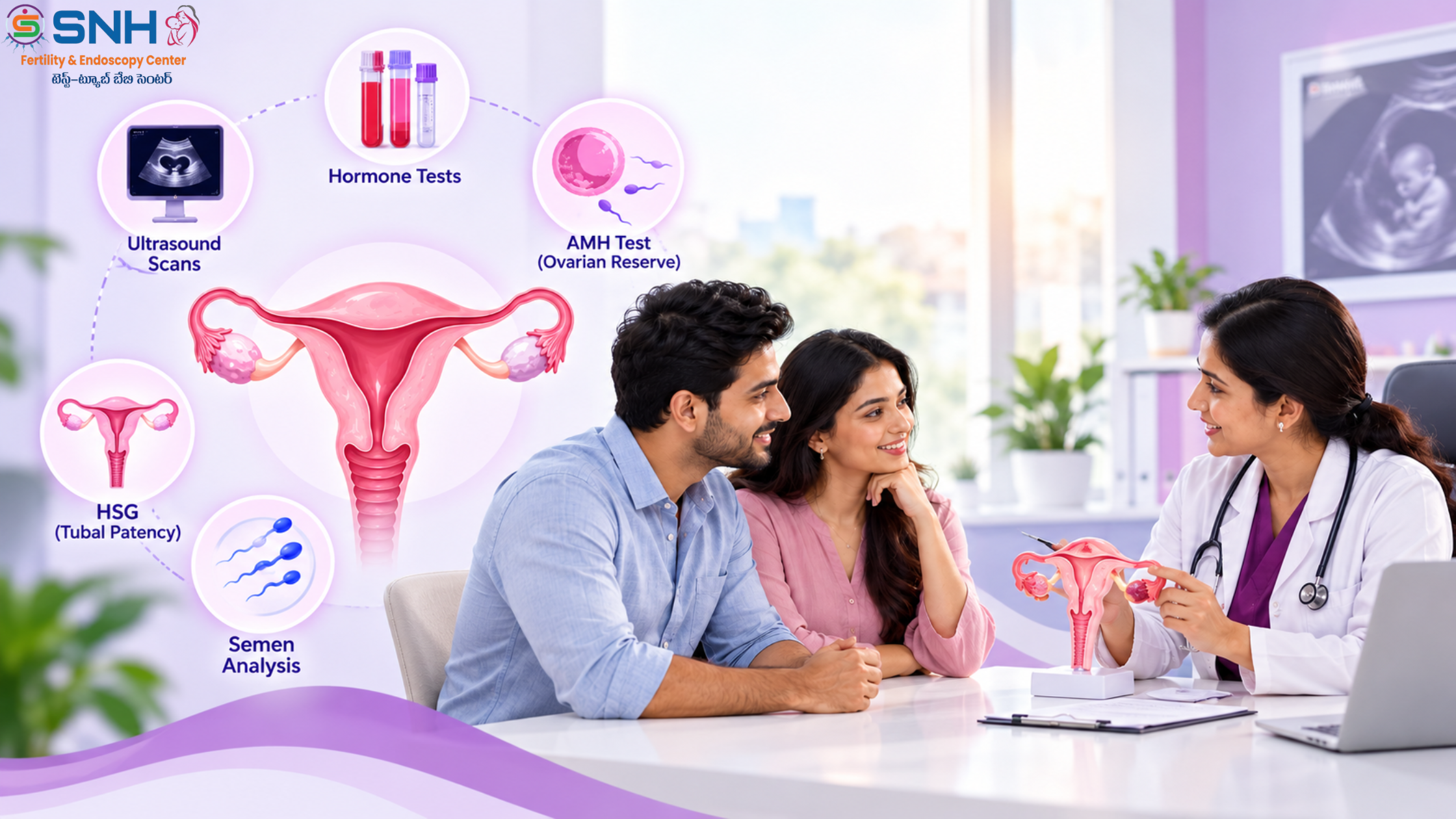
Fertility Tests for Men and Women in Nellore
Trying to conceive can be an emotional and confusing experience, particularly when pregnancy does not occur as expected. A fertility evaluation can help identify factors that may be affecting conception and help couples understand the treatment options available to them.
For couples searching for trusted fertility hospitals in Nellore, it is important to choose a fertility center where both partners can receive appropriate evaluation and personalized medical guidance.
At SNH Fertility & Endoscopy Center, fertility assessment and treatment are planned according to the individual’s medical history, reproductive health and specific needs. To understand more about the center and its approach, visit the SNH Fertility & Endoscopy Center.
What Are Fertility Tests?
Fertility tests are medical evaluations used to identify factors that may affect a person’s ability to conceive.
Infertility can be associated with female factors, male factors, factors involving both partners, or sometimes no clearly identified cause. For this reason, fertility evaluation may involve both partners.
According to the World Health Organization (WHO), infertility is a condition affecting the reproductive system and can affect both men and women.
The tests recommended are not the same for everyone. A fertility specialist generally considers factors such as:
- Age
- Duration of trying to conceive
- Menstrual cycle pattern
- Previous pregnancies
- Previous surgeries
- Medical conditions
- Previous fertility treatments
- Male reproductive health
- Previous test results
When Should a Couple Consider Fertility Testing?
A fertility evaluation may be considered when a couple has been trying to conceive without success.
Testing may also be recommended earlier when there are specific concerns such as:
- Irregular or absent periods
- Suspected PCOS
- Endometriosis
- Previous pelvic surgery
- Previous pelvic infection
- Recurrent pregnancy loss
- Known problems affecting the reproductive system
- Previous testicular or reproductive problems
- Concerns about sperm count or sperm movement
- Age-related fertility concerns
The appropriate timing of evaluation depends on the individual situation. A fertility specialist can recommend the investigations that are relevant rather than performing every possible test.
Fertility Tests for Women
Female fertility testing may involve several investigations depending on symptoms, age, menstrual history and medical history.
- Ovulation Assessment
Ovulation is the process in which an egg is released from the ovary.
If ovulation is irregular or absent, conception may become more difficult. Doctors may assess ovulation using:
- Menstrual history
- Ultrasound monitoring
- Follicular monitoring
- Hormonal blood tests
- Other investigations when clinically appropriate
Women with irregular periods may need additional evaluation to determine the underlying cause.
- AMH Test
AMH, or Anti-Müllerian Hormone, is one test that may be used when assessing ovarian reserve.
AMH can provide information about the approximate number of follicles remaining in the ovaries. However, AMH alone cannot determine whether a woman can or cannot become pregnant.
Age, egg quality, ovulation, fallopian tube function, sperm factors and other reproductive factors also influence fertility.
Therefore, if you are looking for trusted fertility hospitals in Nellore because of a low or high AMH result, it is important to discuss the result with a fertility specialist rather than interpreting the number independently.
- Hormonal Blood Tests
Depending on the patient’s symptoms and medical history, a doctor may recommend different hormonal investigations.
These may include tests related to:
- FSH
- LH
- Estradiol
- AMH
- TSH
- Prolactin
The timing of some hormone tests can matter, and the appropriate tests depend on the clinical situation.
- Pelvic Ultrasound
A pelvic ultrasound allows doctors to examine reproductive organs and can provide information about:
- Uterus
- Ovaries
- Endometrial lining
- Follicles
- Fibroids
- Ovarian cysts
- Certain structural abnormalities
Ultrasound may also be used for follicular monitoring, which helps doctors assess follicle development and ovulation during a treatment cycle.
- HSG – Fallopian Tube Test
The fallopian tubes play an important role in natural conception because they provide the pathway where sperm and egg can meet.
HSG (Hysterosalpingography) is an imaging procedure that can be used to evaluate the uterine cavity and whether the fallopian tubes appear open.
If a doctor suspects tubal blockage, HSG or another appropriate investigation may be recommended.
Fertility Tests for Men
Male fertility evaluation is equally important because male factors can contribute to difficulty conceiving.
- Semen Analysis
A semen analysis is one of the primary investigations used to assess male fertility.
It can provide information about characteristics of semen and sperm, including:
- Sperm concentration
- Sperm movement or motility
- Sperm morphology
- Semen volume
- Other semen parameters
A single semen analysis may not always provide the complete picture. If results are abnormal, a doctor may recommend repeat testing or additional evaluation.
- Male Hormone Tests
When clinically indicated, blood tests may be used to evaluate hormones involved in reproductive function.
Depending on the patient’s history and examination, a doctor may consider tests such as:
- Testosterone
- FSH
- LH
- Prolactin
- Other investigations when required
Hormonal testing is not necessarily required for every man and is generally guided by the clinical assessment.
- Physical and Medical Evaluation
A fertility specialist may also consider:
- Previous testicular problems
- Previous surgeries
- Certain infections
- Medications
- Lifestyle factors
- Sexual or reproductive history
- Previous fertility problems
Additional tests may be considered when abnormalities are identified.
Why Should Both Partners Be Evaluated?
One of the most important points about fertility testing is that fertility evaluation should not automatically focus only on the woman.
Difficulty conceiving can have male factors, female factors, combined factors or unexplained causes.
Evaluating both partners can therefore provide a more complete understanding of the couple’s reproductive health.
For couples exploring treatment options after their evaluation, the IVF and infertility services at SNH Fertility & Endoscopy Center provide information about fertility treatment options that may be considered according to individual circumstances.
What Happens After Fertility Testing?
The next step depends on the test results.
A fertility specialist may recommend:
If ovulation is irregular
Further evaluation and appropriate treatment may be considered.
If PCOS is identified
The doctor may discuss ovulation management and other fertility options based on the individual’s needs.
If fallopian tube problems are identified
Further evaluation or appropriate fertility treatment may be discussed.
If sperm parameters are abnormal
The doctor may recommend repeat semen analysis, additional investigations or fertility treatment depending on the findings.
If multiple factors are identified
Treatment may address more than one factor.
If no clear cause is identified
The couple may be diagnosed with unexplained infertility after appropriate evaluation, and treatment options can still be discussed.
When Is IVF Considered?
IVF, or in vitro fertilization, is a fertility treatment in which eggs are retrieved and fertilized with sperm in a laboratory, with an embryo subsequently transferred to the uterus.
IVF may be considered in certain situations, including some cases involving:
- Blocked fallopian tubes
- Certain male-factor fertility problems
- Some ovulation-related fertility problems
- Endometriosis
- Unexplained infertility
- Previous unsuccessful fertility treatments
However, IVF is not automatically the right treatment for every couple. The appropriate approach depends on factors such as age, test results, duration of infertility and previous treatment.
Couples considering treatment can also review the SNH fertility specialists to learn more about the doctors providing fertility care.
How to Prepare for a Fertility Consultation
Before visiting a fertility specialist, it can be useful to keep information about:
- Menstrual cycle dates
- Previous pregnancy records
- Previous ultrasound reports
- Previous fertility test results
- Medical conditions
- Previous surgeries
- Current medications
- Previous fertility treatments
- Semen analysis reports, if available
Having previous medical records available can help the doctor understand the complete history.
How to Choose a Fertility Hospital in Nellore?
When searching online for trusted fertility hospitals in Nellore, couples should look beyond the name of the hospital and consider practical factors such as:
- Availability of fertility specialists
- Range of diagnostic services
- Fertility treatment options
- Experience in managing different infertility conditions
- Availability of appropriate laboratory facilities
- Individualized treatment planning
- Clear communication about investigations and treatment
- Follow-up and support throughout treatment
A fertility consultation can help you understand which tests are appropriate for your particular situation.
Frequently Asked Questions
What is the first fertility test for a woman?
There is no single fertility test that is appropriate for every woman. Depending on the situation, evaluation may include menstrual history, ovulation assessment, blood tests, ultrasound and assessment of the fallopian tubes.
What is the first fertility test for a man?
A semen analysis is commonly one of the initial investigations used to assess male fertility.
Can both husband and wife undergo fertility testing?
Yes. Evaluating both partners can help identify male factors, female factors or factors involving both partners.
Does AMH determine whether I can get pregnant?
No. AMH is one indicator related to ovarian reserve, but it does not independently determine whether pregnancy is possible.
Can blocked fallopian tubes affect pregnancy?
Yes. Blocked or damaged fallopian tubes can interfere with the normal meeting of sperm and egg. Tests such as HSG may be used to assess tubal patency.
Is IVF required for every infertility case?
No. Treatment depends on the cause of infertility, age, test results and individual circumstances. Some couples may be managed with other approaches, while IVF may be considered in specific situations.
Where can I get fertility evaluation in Nellore?
Couples looking for trusted fertility hospitals in Nellore can consider a fertility consultation at SNH Fertility & Endoscopy Center to discuss their medical history and determine which fertility tests may be appropriate.
Fertility testing is an important step toward understanding why pregnancy may not be occurring. Women may require evaluation of ovulation, ovarian reserve, hormones, the uterus and fallopian tubes, while men may require semen analysis and, when appropriate, hormonal or additional evaluation.
Most importantly, fertility evaluation should be individualized for both partners rather than relying on a single test.
If you are searching for trusted fertility hospitals in Nellore, SNH Fertility & Endoscopy Center provides fertility evaluation and treatment services based on individual patient needs. A consultation can help you understand which investigations may be appropriate and what treatment options may be considered based on the results.